


Polo Latest
Contract Sewing vs In-House Manufacturing: Cost, Risk & Scalability Breakdown
When OEMs evaluate whether to keep production in-house or partner with a contract sewing manufacturer, the conversation almost always starts with cost. But in reality, the decision runs much deeper. The real question is how your manufacturing strategy impacts risk, scalability, and long-term growth.
For companies operating in the industries we serve, this decision can directly influence product quality, timelines, and ultimately, customer trust. Below is a practical breakdown of how in-house manufacturing compares to contract sewing—and where each approach fits.
Understanding the True Cost of Manufacturing
At a glance, in-house manufacturing can feel like the more cost-effective option. You already have a facility, a team, and maybe even equipment in place. It creates a sense of control, and on paper, it may seem like you’re saving money by keeping everything internal.
However, the true cost of in-house production is often underestimated.
Beyond labor, in-house manufacturing includes:
- Labor (operators, supervisors, training)
- Equipment purchase and maintenance
- Facility overhead (rent, utilities, insurance)
- Material sourcing and inventory management
- Quality control and compliance costs
- Downtime, inefficiencies, and scrap
These costs are fixed and ongoing, regardless of production volume.
In contrast, contract sewing converts many of these fixed costs into predictable, variable costs. A qualified manufacturing partner spreads overhead across multiple programs, invests in process optimization, and delivers pricing that reflects efficiency at scale.
In many cases, what appears to be “more expensive” upfront becomes significantly more cost-effective over time.

Risk: The Factor That’s Often Overlooked
While cost drives initial conversations, risk is where most OEMs encounter challenges. In-house manufacturing introduces several hidden vulnerabilities such as:
- Single point of failure (facility shutdowns, labor shortages)
- Limited expertise in specialized processes (RF sealing, advanced textiles, etc.)
- Compliance gaps (FDA, ISO, validation requirements)
- Inconsistent quality due to process variability
- Difficulty scaling without introducing errors
Most companies don’t realize the risk until something goes wrong—missed deadlines, product failures, or regulatory setbacks.
Maintaining standards such as ISO certifications or FDA requirements demands constant oversight. Without dedicated systems and experienced personnel, the risk of non-compliance increases.
A strong contract sewing partner is designed to reduce these risks.
Instead of building infrastructure from scratch, you gain access to established quality systems, validated processes, and experienced engineering teams. Redundancy across multiple facilities—both domestic, nearshore, and global—adds an additional layer of protection, ensuring continuity even when challenges arise.
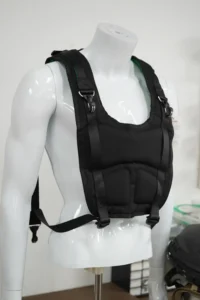
One recent project involved an OEM customer of ours attempting to design tactical vests and a specialized medical pouch internally but failed to comply with strict Berry Amendment regulations (which require U.S.-made materials and labor). They also struggled with the required heavy-duty sewing techniques and associated equipment costs. Polo’s in-house engineering and manufacturing teams were then brought in to ensure compliance, durability, and ultimately a successful product launch.
Scalability: From Prototype to Production
Scalability is often the tipping point in this decision.
In-house manufacturing can work well in early stages, especially during prototyping or low-volume production runs. But as demand grows, internal systems are quickly put under pressure. Expanding capacity requires hiring and training new employees, purchasing additional equipment, and potentially reconfiguring facilities—all of which take time and capital.
This is where many companies begin to feel the strain. Growth slows, timelines extend, and quality can become inconsistent during ramp-up.
Contract sewing manufacturers, on the other hand, are built with scalability in mind. Their operations are designed to support everything from early-stage development to high-volume production. With flexible labor models, optimized workflows, and access to automation, they can scale production without compromising quality.
More importantly, we’ve done it before.
We’ve built our operation to handle growth the right way. With over 165,000 sq. ft. of manufacturing space and another 100,000 sq. ft. of warehouse space, we’re set up to support true high-volume production. That means we can ramp when you need it, manage inventory without scrambling, and keep things moving as demand picks up. We’re also continuing to expand our facilities to better support our customers long-term.

The Role of Expertise in Manufacturing Decisions
Manufacturing is not just about producing a product—it’s about producing it efficiently, consistently, and at scale. That requires deep knowledge of materials, processes, and design considerations.
A true partner contributes far more than production capacity. They bring insight into material selection, design for manufacturability (DFM), and process optimization. They help identify potential failure points early and guide decisions that improve performance and speed to market.
Choosing the right manufacturing path isn’t just about today’s costs—it’s about positioning your business for long-term success, scalability, and reliability. If you’re ready to reduce risk, improve efficiency, and scale with confidence, it may be time to explore a better approach.
👉 Request a quote today and see how the right manufacturing partner can support your next project.
