



Polo Latest
Troubleshooting 6 Common RF Sealing Problems in Fluid Containment Products
RF sealing defects can significantly impact fluid containment product performance and reliability. This article explores six common RF sealing problems—including weak welds, over-welding, arcing, pinholes, inconsistent weld quality, and obstructed flow paths—while highlighting early warning signs PD & Quality should monitor.
Troubleshooting 6 Common RF Sealing Problems in Fluid Containment Products
Fluid containment products play a critical role across medical, defense, and safety applications. Whether it’s a drainage bag, fluid collection system, specimen pouch, or wearable medical device, the integrity of every RF-sealed joint directly impacts product performance and reliability.
Radio Frequency (RF) sealing remains the most effective manufacturing method for creating strong, repeatable bonds in thermoplastic materials. However, even minor process variations can create defects that compromise fluid containment, increase product risk, and lead to quality issues.
Understanding the most common RF sealing problems—and recognizing their early warning signs—can help product development & quality management teams improve product reliability and avoid failures before products reach the field.
1. Weak or Incomplete Welds
One of the most common RF sealing defects is an incomplete weld. At first glance, the seal may appear acceptable, but mechanical testing often reveals insufficient bond strength.
Incomplete welds can result from:
- Inadequate RF energy
- Improper cycle times
- Material variation
For fluid-filled products, weak welds become especially problematic once internal pressure is introduced. A seal that survives initial inspection may begin to separate during filling, transportation, or end-use.

Early Indicators
Engineers should watch for:
- Reduced peel strength during validation testing
- Visual inconsistencies along the weld path
- Sections of the weld that separate under moderate stress
When left unaddressed, incomplete welds can become direct leak paths that compromise product during in-field performance.
2. Over-Welding and Material Degradation
While insufficient energy can create weak seals, excessive energy creates an entirely different problem.
Over-welding occurs when too much heat is generated during the RF sealing process. The weld itself may appear strong, but the surrounding material becomes weakened.
In many fluid containment applications, pressure is distributed throughout the product. If the material adjacent to the weld becomes excessively thin, failure may occur outside the seal line rather than within it.
Early Indicators
Signs of over-welding often include:
- Material thinning near the weld area
- Discoloration or excessive gloss changes
- Reduced flexibility adjacent to the weld
Product development and quality teams should remember that the strongest-looking weld is not always the most durable weld. Achieving the proper balance between bond strength and material integrity is essential.
3. RF Arcing and Burn Defects
RF arcing is among the most damaging defects in RF welding operations.
Arcing occurs when RF energy concentrates at a specific point rather than distributing evenly across the weld area. This localized energy spike creates excessive heat that burns the material.
Contamination, foreign particles, tooling damage, or material inconsistencies can all contribute to arcing events.
In fluid containment products, even a microscopic burn-through can become a leak path.
Early Indicators
Common warning signs include:
- Burn marks or discoloration
- Small holes near the weld zone
- Unexpected process instability
- Audible snapping or popping during the weld cycle
Because some arc events can be difficult to detect visually, robust quality inspection procedures are essential for high-reliability applications.
4. Pinholes in Film Materials
Not all fluid containment failures originate during the sealing process.
Pinholes can exist within raw film materials before RF welding even begins. These microscopic defects may allow fluid, air, or contaminants to pass through an otherwise properly manufactured product.
Pinholes are particularly challenging because they often remain invisible during routine visual inspections.
Early Indicators
Manufacturers should consider:
- Incoming material inspection programs
- Leak testing procedures
- Supplier quality controls
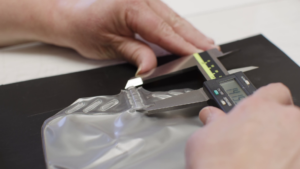
- Tensile Testing
- Pressure Decay Testing
- AQPQ (Advanced Product Quality Planning) processes
When troubleshooting fluid leakage, it is important to evaluate both the weld and the base material itself.
5. Inconsistent Weld Quality
Consistency is often the difference between a successful product launch and ongoing production challenges.
Several factors can create inconsistent weld quality, including:
- Tool wear or damage
- Poor tooling flatness
- Material thickness variation
- Machine setup inconsistencies
These issues may cause certain sections of a weld to bond properly while others remain weak or incomplete.
For fluid-filled products, pressure naturally seeks the weakest point. Even a small discontinuity can eventually develop into a failure location.
Early Indicators
Quality teams should look for:
- Variability between production runs
- Irregular weld appearance
- Localized seal failures
- Differences in peel-test results
6. Uneven Melt Flow and Obstructed Fluid Pathways
Many fluid containment products require both sealed chambers and controlled fluid pathways.
During RF sealing, melted material naturally flows within the weld zone. If tooling design, material distribution, or process parameters are not optimized, material can flow into unintended areas.
This may restrict or completely block critical fluid channels.
Early Indicators
Potential warning signs include:
- Reduced flow rates during testing
- Inconsistent product performance
- Dimensional variation within flow paths
- Unexpected pressure buildup
For engineers designing fluid management systems, understanding material flow behavior during RF sealing is just as important as achieving seal strength.
Designing for Long-Term Fluid Containment Reliability
Successful fluid containment products require more than a strong seal. They depend on a combination of material selection, tooling design, process control, and quality validation.
At Polo Custom Products, our engineering and manufacturing teams work closely with OEMs to identify potential RF sealing challenges early in product development. Through design-for-manufacturability reviews, process validation, material expertise, and production testing, potential failure modes can often be addressed before they become costly production or field issues.
Whether developing a medical drainage bag, industrial fluid containment system, or specialty sealed product, understanding these common RF sealing problems is an important step toward improving product performance, reducing risk, and ensuring long-term reliability.
