


Polo Latest
6 Ways Early Engineering Reviews Eliminate Hidden Production Costs
A part can meet every specification on an engineering drawing and still be unnecessarily expensive to produce. Extra material handling, secondary cutting steps, and tooling requiring constant operator adjustment quietly inflate unit costs once production scales.
Reducing those costs doesn’t happen on the assembly line. It starts in product development. When engineers, designers, sourcing specialists, and quality teams collaborate before production begins, they spot cost drivers hidden in drawings and material specs.
On our Inspiring Innovations podcast, Project Engineer Derek Severson, who sits “at the pointy end of the stick when it comes to new products and product launches,” broke down how early engineering decisions translate directly into lower costs and smoother shop-floor production.
01
Resolve Drawing Conflicts Before Building Tooling
Effective product development starts during quoting. Before estimating tooling or locking in a manufacturing approach, an assigned project engineer and sourcing specialist evaluate customer files to establish material pricing and production feasibility.
Often, the first hurdle is conflicting documentation. A customer might provide a physical sample built one way alongside a drawing calling out a different method, or a harness print might overlook subdrawings clarifying how webbing routes through hardware.
“Probably the first question that we’re bouncing back to the customer is: Here’s what the differences are between your sample and whatever other inputs we’ve been given. What do you actually want us to build to?”
Derek Severson, Project Engineer
Catching these discrepancies upfront, through redlined drawings and dimension clarifications, prevents costly tooling rework, repeated sampling loops, and delayed launch timelines.
02
Use DFM to Eliminate Secondary Operations
Design for manufacturability (DFM) examines how specific design choices affect labor, equipment, and risk. Sometimes a minor geometric adjustment removes an entire step from the process.
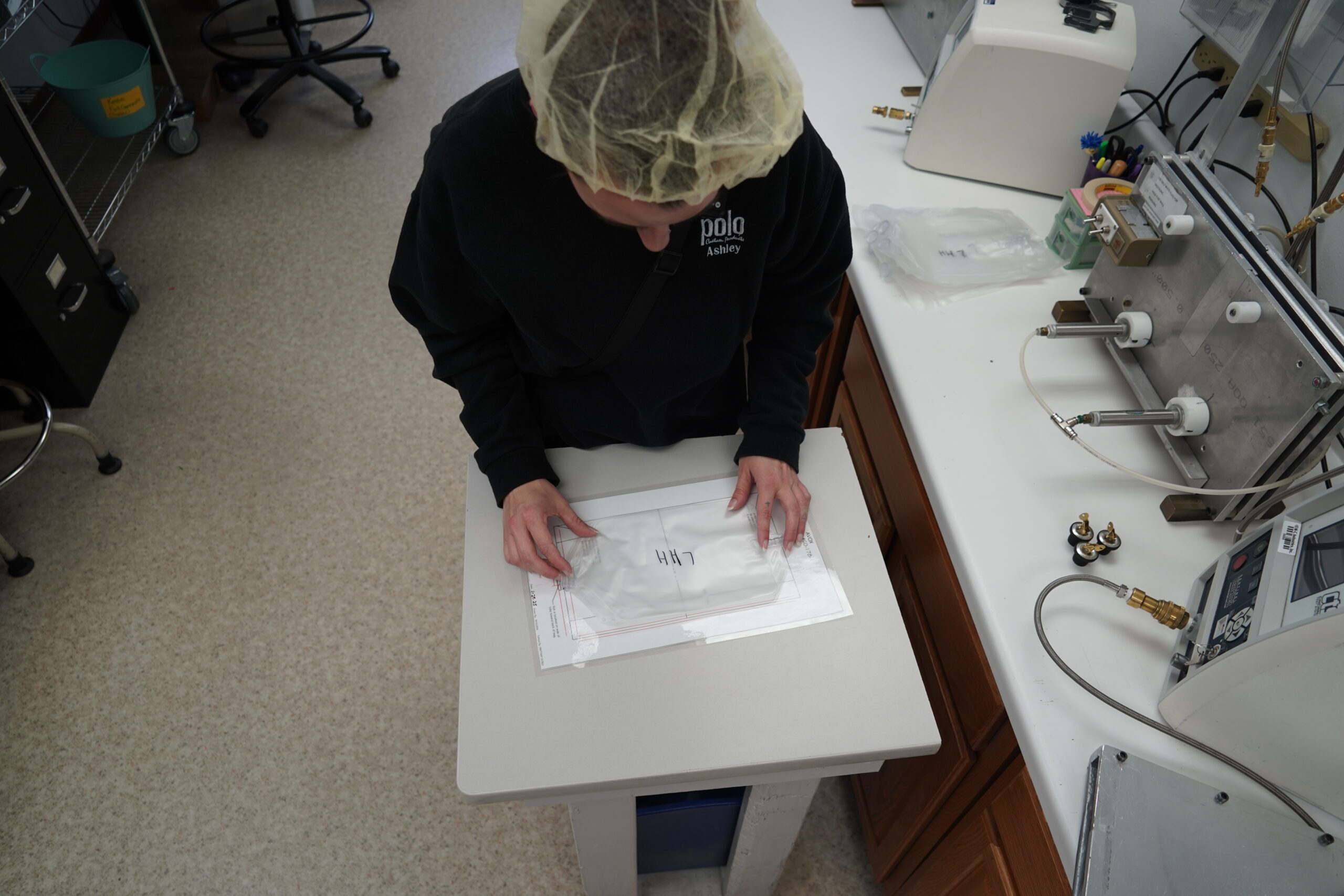
Derek shared a recent example involving a medical product with RF-welded bladders tucked inside a sewn outer shell. The customer’s drawing showed the weld seal extending to the material’s edge. Welding right to the edge would have required sealing the bladder first and running a secondary cutting operation to trim a clean edge.
“I went back to the customer and said, ‘I can either add that secondary cutting operation, add cost, and make it an inferior process because now you’re introducing another potential failure point and potentially causing a leak in that bladder.’ Instead, I proposed that we just narrowed the seal width and kept the internal volume the same. That left enough clearance to the edge of the material to where RF welding works, I don’t need a secondary cutting operation, and it still meets expectations.”
Derek Severson, Project Engineer
03
Match the Joining Method to the Material and Application
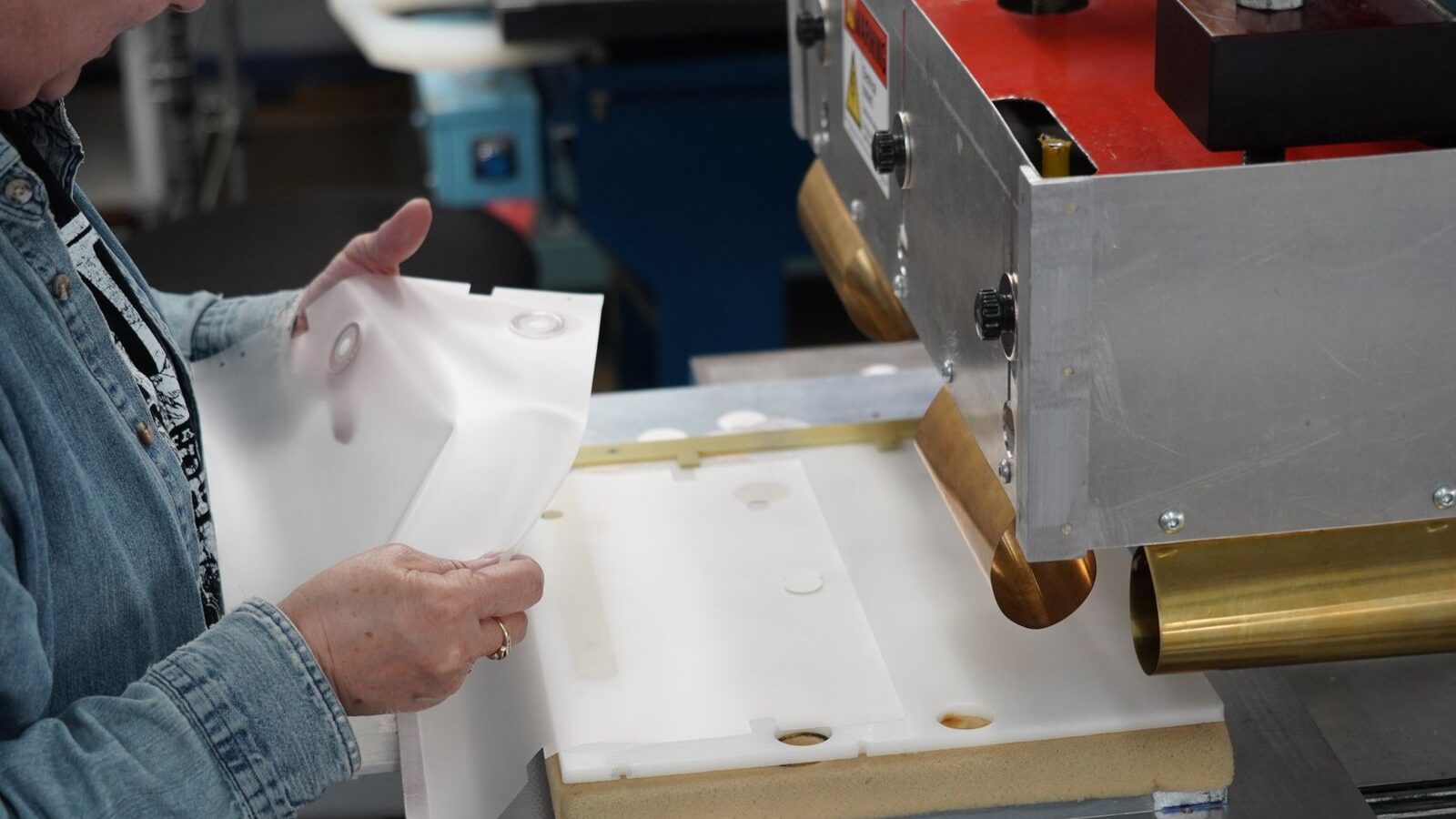
While radio frequency (RF) welding is often the first choice for strong, repeatable seals in flexible thermoplastics, end-use environments and material formulations should always dictate the process.
RF welding acts like a targeted microwave, exciting polar plastic molecules with an alternating electromagnetic field to generate internal heat. However, non-polar plastics or chemical additives like carbon black interfere with how the material heats, hurting weld reliability.
“Customer requirements and end use. That’s really what drives the decision initially. We’ve run into materials that have carbon black as an addition to the plastic. You can heat carbon black to an extent with RF, but it makes using RF welding far more difficult. So we may end up going to something like impulse welding just because the additives are making RF welding not as reliable of a process as what we need.”
Derek Severson, Project Engineer
Engineering evaluates multiple in-house methods, including RF welding, impulse welding (using rapid electrical heating elements and water-cooled pads), hot air welding, and ultrasonic welding, to select the most stable process.
04
Engineer Fixtures and Cutting Methods for Repeatability
An engineer building a handful of prototypes can carefully align each layer and smooth out variables by hand. Relying on that manual finesse across a full production run adds labor and introduces part variation.
“When you’re having an engineer run the parts and they’re only running a couple at a time, you’re able to pay a lot more attention to how things are aligned. When we go to full production, it’s unrealistic to expect our operators to put that much time and attention into an individual product, and even then, that’s not a very controlled process.”
Derek Severson, Project Engineer
To build repeatability directly into the workstation, engineering evaluates:
- Operator Aids: Custom fixtures, improved material-locating features, and go/no-go quality gauges.
- Scalable Tooling: Moving from single-cavity sample tools to multi-up tooling (producing several parts per cycle) paired with dual-tray turntables to boost throughput.
- Tailored Cutting Methods: CNC knife cutting efficiently slices multiple layers of breathable textiles with minimal scrap, while die cutting or laser cutting delivers tighter tolerances for non-breathable films and pin-located welds.
05
Balance Upfront Tooling Costs With Long-Term Needs
The lowest-priced tool on a quote often carries the highest operating cost over a program’s lifespan. Selecting the right tooling means weighing upfront cost and lead time against annual volume, geometry, and service life.
| Tooling option | Strengths | Where it fits |
|---|---|---|
| Wood-backed steel-rule die | Very fast and very accurate | Prototypes, shorter runs, and complicated geometries |
| Forged heavy-duty die | Longer life and more layers cut at a time, with five to six times the cost and more design restrictions | High-volume production and tough multi-layer materials |
| Brass RF welding die | Durable and easier to repair on the floor | RF welding dies where durability and quick repairs matter |
| Aluminum tooling | Lighter operator handling | Base plates and locating features |
“With dies, we generally do either wood-backed steel-rule dies, which are very fast, very accurate, and really good for complicated geometries, or a forged heavy-duty die. A forged die is five to six times more expensive, and more design-restricted, but they last far longer and let us cut more layers of material at a time, so you get labor savings there.”
Derek Severson, Project Engineer
For RF welding dies, engineers weigh similar trade-offs between brass (valued for durability and easier floor repairs) and aluminum (ideal for base plates, locating features, or lighter operator handling). Because Polo Custom Products designs and builds much of its tooling in-house, engineers modify dies directly on the floor during sampling rather than waiting weeks for an outside vendor.
06
Carry Development Data Onto the Production Floor
For medical and industrial programs requiring formal validation, development doesn’t end when a sample passes inspection. Engineers lock down constant machine settings and run structured tests across variable ranges to establish a stable process window.
“With sealing especially, you kind of have to treat every single product, every single material, and every single tool as their own distinct entity. We don’t actually have a formal handoff all the way to production until after first production has been completed. We have a postmortem meeting to determine if there is additional development work needed before a full handoff occurs.”
Derek Severson, Project Engineer
All validated machine parameters, material specs, work instructions, and target production rates are documented in the Bill of Manufacturing (BOM), connecting upfront engineering decisions directly to daily production consistency.
07
Frequently Asked Questions About Early Engineering Reviews
Ready for a Manufacturing Review?
Have a part moving toward production? Share your drawings, samples, and performance requirements with the engineering team at Polo Custom Products to identify opportunities to simplify tooling, eliminate secondary operations, and lower total part cost.
