



Polo Latest
RF Sealing Explained: How It Works, Seal Types & Common Uses
RF sealing, also called RF welding or dielectric welding, uses radio frequency energy and pressure to permanently join compatible plastic materials. The energy generates heat within the material along a defined seal area. Once the layers bond, they cool under pressure before the finished product is released.
For OEMs developing flexible products, RF sealing offers a way to create consistent seams, incorporate tubing and valves, and form separate compartments. Choosing the right approach starts with understanding the material, the product’s function, and the type of connection needed. Request a Quote to work with our product development team on enhancing your project needs.
01
How Does RF Sealing Work?
RF sealing typically operates at a frequency of 27.12 MHz. The changing electrical field causes electrically responsive molecules within the plastic to move, generating heat. As the material begins “melting” in the seal area, pressure brings the layers together.
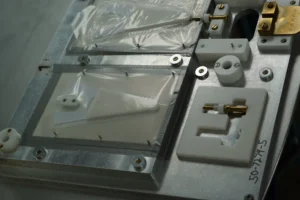
The equipment combines an RF generator with a press and interchangeable tooling. The tooling determines where the seal forms and what shape it takes. Polo works with OEMs to determine the ideal shape and tooling for each project. We then order the tooling and begin making production samples.
A typical sealing cycle follows five steps:
- The press closes, bringing the tooling against the material.
- RF energy heats the intended seal area.
- The material layers bond, and the energy stops.
- The seal cools while the tooling maintains pressure.
- The press opens, releasing the finished product.
That cooling period matters. Holding the layers together as they cool helps the newly formed seal set before the product is handled.
Energy, pressure, heating time, and cooling time must work together. The right settings depend on the material and product design.
02
Is RF Sealing the Same as RF Welding?
RF sealing and RF welding describe the same joining process. High-frequency welding and dielectric welding are other names commonly used for it.
The process depends on how the material responds to RF energy. Not every plastic can be sealed this way, so material compatibility should be evaluated early.
The number of layers, material thickness, and seal shape also affect the manufacturing approach. A process that works for a simple two-layer product may need different tooling or settings for a more advanced or multi-layer assembly.
03
What Types of RF Seals Are Available?
Different product features require different connections. RF tooling can produce several seal types within the same assembly.
| Seal type | What it does | Where it fits |
|---|---|---|
| Flat or lap seal | Bonds overlapping material layers | Perimeter seams and internal divisions |
| Tear seal | Bonds layers and creates a removable waste border | Shaped products needing a clean finished edge |
| Tube seal | Joins tubing to a flexible product | Air or fluid connections |
| Port or valve seal | Bonds a molded fitting to the material | Filling, draining, or inflation openings |
Flat or Lap Seals
A flat or lap seal joins overlapping layers without creating a tear-away border. It is a basic seal that can be produced with relatively simple tooling.
Tear Seals
A tear seal joins the layers while thinning the material along an outside border. After sealing, the surrounding waste can be stripped away.
At Polo Custom Products, tear seals are the most commonly used RF seal type. They are useful when the finished product needs a smooth edge without excess material extending beyond it.
Tube, Port, and Valve Seals
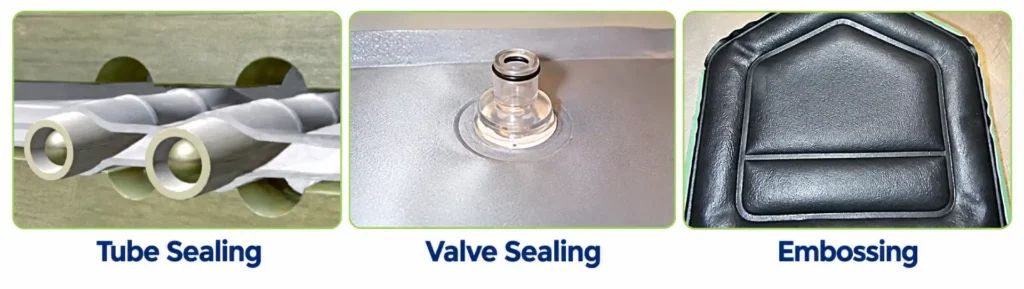
Tube seals connect tubing to bags or inflatable devices. A mandrel placed inside the tube supports the connection during sealing.
Port and valve seals attach molded fittings with flat flanges, typically around precut openings in the material. These connections allow the product to be filled, emptied, or inflated.
RF tooling can also emboss lettering, logos, or designs into compatible plastic surfaces.
04
Why Does RF Tooling Matter?
Tooling controls where pressure and energy reach the material. Its condition and design directly affect seal consistency.
Brass is commonly used because it conducts electricity well, transfers heat evenly, and is easy to machine and repair.
The tooling also needs to close evenly across the seal area. Uneven contact can affect how pressure is distributed.
Unintended sharp edges and corners can concentrate electrical energy, increasing the risk of arcing. An arc can damage the film and the material supporting it, even when an arc-suppression system stops the energy quickly.
These details explain why tooling is an engineering consideration, rather than simply a shape made to match a drawing. Polo Custom Products uses a multistage quality system to verify strength and consistency across high-volume RF-sealed production runs. We adapt our quality processes to meet each customer’s needs and the regulatory requirements of their project.
05
How Are More Complex Products Sealed?
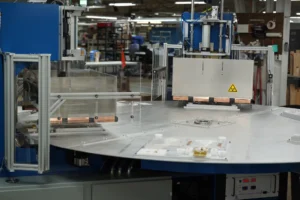
Products with tubing may use double-cycle equipment, also called switching head tooling. This equipment performs separate RF sealing operations during one press closure, allowing the tube connection and surrounding seals to receive different settings.
Production equipment can also use shuttle stations or rotary tables. These arrangements allow material to be loaded at one station while another station is sealing.
The best configuration depends on how complex the product is, production quantity, and how frequently tooling must change.
06
How Does RF Compare With Other Sealing Options?
RF sealing generates heat within compatible materials. Heat sealing and impulse sealing transfer heat from the tooling into the material. Ultrasonic sealing uses mechanical vibration to generate heat at the joint.
Each process has different material and design considerations. The choice should account for seal size, material compatibility, appearance, and production requirements.
07
Common Applications By Industry
| Industry | Common RF-sealed applications |
|---|---|
| Aviation | Inflatable life vest bladders, emergency life rafts, oxygen mask system components, and inflatable aircraft recovery bags. |
| Fire & Safety | Inflatable rescue and flotation devices, water recovery lift bags, and inflatable support tubes for emergency shelters and decontamination systems. |
| Medical | Fluid collection and drainage bags, blood bags, inflatable blood pressure cuffs, compression therapy bladders, patient positioning cushions, and fluid-circulating heating or cooling pads. |
| Government & Defense | Hydration and fluid storage bladders, inflatable shelter components, survival rafts, life vest bladders, and protective equipment pouches and covers. |
| Powersports | Waterproof motorcycle panniers, saddlebag liners, tank bags, and dry bags for riding gear and equipment. |
Choosing a Sealing Approach
A sealed product starts with clear requirements and a process suited specially to them.
Polo Custom Products works with OEMs to evaluate product designs, tooling, and sealing requirements. Explore our RF welding capabilities or discuss your project with our team to determine an appropriate manufacturing approach.
